



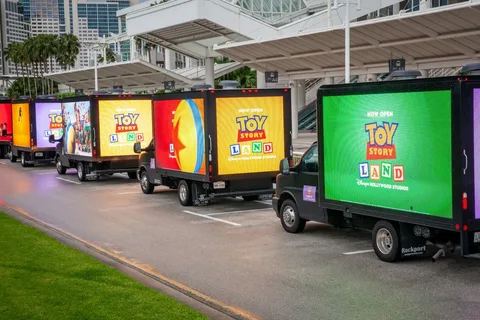
For decades, out-of-home (OOH) advertising has been dominated by static billboards, bus shelter ads, and posters plastered across urban landscapes. While these traditional methods still hold value, a dynamic and increasingly impactful player has emerged: the advertising truck, often dubbed a “mobile billboard.” These vehicles, wrapped in vibrant and attention-grabbing advertisements, are not just trucks; they are moving canvases that are reshaping how brands connect with their target audiences in the physical world. This article delves into the ways advertising trucks are revolutionizing OOH marketing, offering unparalleled flexibility, reach, and creative potential.
Breaking Free from Fixed Locations: The Power of Mobility
The most significant advantage of advertising trucks lies in their inherent mobility. Unlike static billboards that are confined to a single location, mobile billboards can traverse entire cities, suburbs, and even travel between regions. This dynamic nature allows advertisers to target specific demographics and geographic areas at precisely the right time. For instance, a coffee brand can deploy an advertising truck near office buildings during morning commutes or outside shopping malls on weekends. This targeted approach maximizes exposure to potential customers, leading to higher engagement and recall compared to a static ad viewed by a diverse and potentially uninterested audience.
Furthermore, mobile billboards can follow events and festivals, tapping into large gatherings of people with specific interests. Imagine a food delivery service advertising near a music festival or a new fitness app promoting its services near a marathon route. This ability to align advertising with relevant events and locations offers a level of precision that traditional OOH methods simply cannot match.
Capturing Attention in a Cluttered Environment: Visual Impact and Creative Freedom
In today’s visually saturated world, grabbing attention is paramount. Advertising trucks offer a unique canvas for creativity. Full vehicle wraps transform ordinary trucks into rolling works of art, allowing for bold graphics, striking imagery, and memorable slogans that can’t be easily ignored. The sheer size and movement of these mobile billboards inherently draw the eye, cutting through the visual clutter of urban environments.
Moreover, advancements in printing technology allow for high-resolution, photo-quality graphics that can bring brands to life in a compelling way. Interactive elements, such as QR codes that lead to online promotions or social media pages, can also be seamlessly integrated into the design, bridging the gap between the physical and digital worlds. This creative freedom allows brands to tell a more engaging story and leave a lasting impression on viewers.
Cost-Effectiveness and Measurable Impact: Challenging Traditional Metrics
While the initial investment in wrapping a truck and managing its operation might seem significant, advertising trucks can offer a cost-effective solution compared to securing prime locations for static billboards for extended periods. The ability to reach a wider and more targeted audience over time can translate to a lower cost-per-impression.
Furthermore, the movement of advertising trucks allows for more sophisticated tracking and measurement of campaign effectiveness. GPS technology can monitor the routes taken and the areas covered, providing valuable data on reach and frequency. While direct attribution can be challenging for OOH advertising in general, techniques like geofencing and correlating website traffic or footfall in specific areas with truck deployments can offer insights into the campaign’s impact. This data-driven approach allows advertisers to optimize their strategies and demonstrate a clear return on investment.
Overcoming Limitations and Navigating Regulations: The Road Ahead
Despite their numerous advantages, advertising trucks also face certain limitations. Traffic congestion and parking restrictions can sometimes hinder their movement and visibility. Additionally, regulations regarding mobile advertising vary across different jurisdictions, requiring careful planning and adherence to local laws. Noise restrictions might also limit the use of audio elements in campaigns.
However, the industry is constantly evolving to overcome these challenges. Strategic route planning, utilizing quieter electric vehicles, and working closely with regulatory bodies are all part of the ongoing effort to maximize the effectiveness and minimize the drawbacks of advertising trucks.
The Future is Mobile: Integrating with the Modern Marketing Mix
Advertising trucks are not meant to replace traditional OOH methods entirely but rather to complement and enhance the overall marketing mix. Their ability to generate high impact and targeted reach makes them a valuable asset in integrated campaigns that also include digital advertising, social media, and experiential marketing.
As technology continues to advance, we can expect even more innovative applications of mobile billboards. Imagine trucks equipped with interactive displays, augmented reality experiences, or even the ability to collect real-time data on audience engagement. The potential for advertising trucks to evolve and further revolutionize OOH marketing is immense.
In conclusion, advertising trucks have emerged as a powerful and versatile tool in the out-of-home advertising landscape. Their mobility, visual impact, and increasing measurability offer significant advantages over traditional static billboards. By breaking free from fixed locations and embracing creative possibilities, mobile billboards are not just turning heads; they are driving results and redefining how brands connect with consumers on the move. As technology continues to advance and advertisers become more sophisticated in their targeting and measurement, the role of advertising trucks in the modern marketing mix is only set to grow, solidifying their place as a key player in the revolution of out-of-home advertising.
