



Peru’s Amazon rainforest represents one of the most biodiverse regions on the planet, a sprawling wilderness where life flourishes in extraordinary abundance and variety. Covering approximately 60% of Peru’s territory, the Peruvian Amazon offers wildlife enthusiasts an unparalleled opportunity to encounter species found nowhere else on Earth. From the vibrant macaws of clay licks to the elusive jaguars prowling riverbanks, Amazon wildlife Peru experiences rank among the world’s premier nature destinations for those seeking authentic encounters with wild animals in their natural habitat.
Why Peru’s Amazon Stands Out for Wildlife
Among the nine countries sharing the Amazon Basin, Peru has earned a distinguished reputation for exceptional wildlife viewing opportunities. This distinction stems from several factors that converge to create ideal conditions for both animal populations and the observers who seek them. The Peruvian Amazon contains numerous protected reserves and national parks where conservation efforts have allowed wildlife populations to thrive with minimal human interference.
The country’s commitment to ecotourism has fostered a network of strategically located lodges and research stations positioned in prime wildlife habitats. Many of these facilities were established in collaboration with conservation organizations and indigenous communities, ensuring that tourism revenue supports both environmental protection and local livelihoods. This model has proven remarkably successful, creating economic incentives for forest preservation while providing visitors with world-class wildlife experiences.
Peru’s varied topography contributes significantly to its biodiversity. The Amazon wildlife Peru hosts includes species from lowland rainforests, seasonally flooded forests, cloud forests, and transitional zones. This habitat diversity translates directly into species diversity, with different elevation zones and forest types supporting distinct animal communities.
The Big Five of Amazon Wildlife Peru
While Africa has its famous Big Five safari animals, the Peruvian Amazon boasts its own collection of iconic species that draw wildlife enthusiasts from around the globe. The jaguar reigns as the apex predator and most sought-after sighting, though encounters require exceptional luck and patience. These magnificent cats patrol riverbanks and forest trails, primarily hunting at dawn and dusk. Tambopata and Manu National Park offer the best chances for jaguar sightings in Peru.
The giant river otter presents another flagship species, and Peru contains some of the last remaining populations of these endangered animals. Growing up to six feet long, these charismatic creatures live in extended family groups and hunt cooperatively in oxbow lakes and slow-moving rivers. Their playful behavior and loud vocalizations make them favorites among wildlife photographers.
Harpy eagles, the world’s most powerful raptors, nest in the tallest emergent trees of the Peruvian Amazon. With wingspans exceeding seven feet and talons larger than grizzly bear claws, these magnificent birds hunt monkeys and sloths in the forest canopy. Spotting a harpy eagle requires expert guides familiar with active nest sites.
The pink river dolphin, known locally as “bufeo colorado,” inhabits the murky waters of Amazonian rivers and lakes. These intelligent cetaceans display remarkable agility, navigating flooded forests during high water seasons. Their unusual coloration ranges from gray in juveniles to bright pink in mature adults, particularly during excited behavior.
Tapirs, resembling prehistoric animals with their prehensile snouts, represent the largest terrestrial mammals in the Amazon. These shy, primarily nocturnal herbivores frequent mineral-rich clay licks and riverbanks, where patient observers might encounter them during early morning hours.
Primate Paradise: Peru’s Monkey Diversity
The Amazon wildlife Peru showcases includes an astounding 35 primate species, more than anywhere else in the Amazon Basin. This remarkable diversity offers wildlife watchers almost guaranteed monkey sightings, often encountering multiple species during a single forest walk. Squirrel monkeys travel in troops exceeding 100 individuals, creating spectacular scenes as they cascade through the canopy in coordinated movements.
Howler monkeys announce their presence with guttural roars that carry for miles through the forest, particularly at dawn. Despite their intimidating vocalizations, these large primates are generally peaceful leaf-eaters. Spider monkeys, with their remarkably long limbs and prehensile tails, swing gracefully through the highest canopy levels, while capuchin monkeys demonstrate tool-using intelligence as they crack nuts and probe crevices for insects.
The tiny pygmy marmoset, the world’s smallest monkey weighing just over 100 grams, clings to tree trunks extracting sap, while emperor tamarins sport distinctive white mustaches that would make any Victorian gentleman envious. Night walks reveal night monkeys, the only truly nocturnal primates in the Americas, their enormous eyes adapted for navigating darkness.
Avian Spectacles: Peru’s Incredible Birdlife
With over 1,800 bird species recorded, Peru ranks among the world’s top birding destinations, and the Amazon wildlife Peru region contributes substantially to this diversity. The Peruvian Amazon alone hosts approximately 1,000 bird species, creating endless opportunities for ornithologists and casual bird watchers alike.
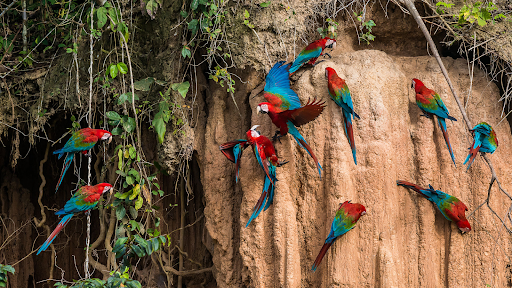
Macaw clay licks provide the Amazon’s most spectacular avian displays. Several locations in southeastern Peru, particularly in Tambopata, feature riverbank cliffs where hundreds of macaws and parrots gather at dawn to consume mineral-rich clay. Scarlet macaws, blue-and-yellow macaws, and red-and-green macaws create living rainbows as they descend in raucous flocks, offering unparalleled photography opportunities.
Toucans of various species bring splashes of color to the canopy, their oversized bills perfectly adapted for reaching fruits on thin branches. Hoatzins, bizarre prehistoric-looking birds with mohawk crests and clawed wings on juveniles, perch conspicuously along waterways. Horned screamers, enormous waterfowl with distinctive calls, frequent oxbow lakes alongside roseate spoonbills, herons, and kingfishers of multiple species.
The forest floor hosts tinamous, partridge-like birds whose melancholic whistles echo through the understory, while antbirds follow army ant swarms to catch fleeing insects. Cotingas, manakins, and tanagers provide brilliant color accents, and hummingbirds of dozens of species hover at flowering plants throughout all forest levels.
Reptiles, Amphibians, and Aquatic Life
The Amazon wildlife Peru encompasses includes remarkable reptilian diversity. Black caimans, reaching lengths of 16 feet, represent the Amazon’s largest predators alongside jaguars. Night boat excursions reveal these formidable reptiles through the red reflection of their eyes in spotlight beams. Smaller spectacled caimans and smooth-fronted caimans are abundant in most water bodies.
Various anaconda species inhabit Peruvian waters, though sightings remain relatively rare due to their aquatic lifestyle and cryptic coloration. Tree boas come in spectacular color morphs, from bright green to deep orange, while numerous other snake species occupy ecological niches from forest canopy to river bottoms.
Amphibian diversity explodes during rainy seasons when breeding choruses fill the night air. Poison dart frogs display warning coloration in electric blues, brilliant yellows, and vibrant reds, advertising their toxic skin secretions. Glass frogs, with transparent abdominal skin revealing internal organs, cling to leaves overhanging streams. Monkey frogs, tree frogs, and numerous other species create the rainforest’s nighttime symphony.
Amazonian rivers teem with fish diversity exceeding 3,000 species. Piranhas, though fearsome in reputation, generally pose little threat to humans. Arapaima, massive air-breathing fish reaching 10 feet and 400 pounds, surface regularly in oxbow lakes. Electric eels generate powerful shocks for hunting and defense, while colorful peacock bass and countless smaller species populate every aquatic environment.
Prime Wildlife Locations in the Peruvian Amazon
Tambopata National Reserve and the adjacent Bahuaja-Sonene National Park in southeastern Peru have established themselves as premier destinations for Amazon wildlife Peru experiences. The region’s clay licks, accessible oxbow lakes, and protected status create optimal conditions for wildlife observation. Numerous eco-lodges provide comfortable bases for exploring this biodiversity hotspot.
Manu National Park encompasses elevation gradients from Andean highlands to lowland rainforest, creating extraordinary biodiversity. This UNESCO World Heritage Site protects over 1,000 bird species and 200 mammal species. Access is more restricted and expensive than Tambopata, but wildlife densities reward the investment for serious naturalists.
Pacaya-Samiria National Reserve, Peru’s largest protected area, offers different experiences focused on flooded forest ecosystems. This vast wetland wilderness, accessible from Iquitos, provides excellent opportunities for pink dolphin sightings, manatees, and aquatic birds while navigating mirror-like channels through seasonally inundated forests.
Allpahuayo-Mishana National Reserve near Iquitos protects unique white-sand forests harboring specialized species found nowhere else, including several endemic bird species highly sought by ornithologists.
Best Times for Wildlife Viewing
Wildlife visibility in the Amazon wildlife Peru varies significantly with seasonal water levels. The dry season, typically June through November, concentrates animals around remaining water sources and exposes riverbanks and trails, generally improving sighting opportunities. Clay lick activity peaks during dry months when macaws visit more regularly. Nesting activity for many bird species occurs during this period, increasing visibility and photographic opportunities.
The wet season, December through May, transforms the forest as rivers flood surrounding areas. Wildlife disperses throughout expanded territories, making individual sightings more challenging but increasing diversity of species encountered. Amphibian activity peaks during wet months, and certain birds display breeding plumage. Flooded forests allow boat access to areas unreachable during other months.
Many experienced naturalists recommend the transition periods of late dry season (October-November) or early wet season (December-January) as optimal times when weather remains relatively manageable while wildlife activity remains high.
Maximizing Your Wildlife Experience
Successful Amazon wildlife Peru observations require patience, realistic expectations, and quality guidance. Wildlife rarely appears on demand in dense rainforest environments. Morning excursions beginning before dawn consistently produce the best sightings as animals are most active during cooler hours. Remaining quiet, moving slowly, and scanning all forest levels improves encounter rates dramatically.
Professional naturalist guides prove invaluable, their trained eyes detecting camouflaged animals invisible to untrained observers. Local guides possess intimate knowledge of individual animal territories, nesting sites, and behavioral patterns accumulated through years of daily forest immersion.
Quality optical equipment enhances the experience significantly. Binoculars rated 8×42 or 10×42 provide optimal magnification and light-gathering for rainforest conditions. Spotting scopes allow detailed observation of distant perches and canopy activity.
Conservation and Responsible Wildlife Tourism
The Amazon wildlife Peru depends on continued habitat protection and sustainable tourism practices. Choosing lodges and operators committed to conservation, employing local guides, and supporting community initiatives ensures tourism benefits both wildlife and indigenous populations. Many excellent facilities contribute portions of revenue directly to conservation programs and local development projects.
Responsible wildlife observation maintains safe distances, never feeding animals or using playback recordings excessively, and following guide instructions without exception. Photography should prioritize animal welfare over perfect shots, avoiding stress-inducing approaches or flash usage that might disturb nocturnal species.
Conclusion
Amazon wildlife Peru offers nature enthusiasts opportunities to witness Earth’s biodiversity at its most spectacular. From dawn macaw flights at clay licks to jaguar tracks on sandy riverbanks, from howler monkey choruses to pink dolphins surfacing in blackwater lagoons, the Peruvian Amazon creates wildlife experiences that transform observers’ understanding of nature’s complexity and wonder.
The combination of accessible infrastructure, protected reserves, experienced local guides, and exceptional species diversity positions Peru as perhaps the premier destination for Amazon wildlife encounters. Whether your passion focuses on big cats, primates, birds, reptiles, or simply immersing yourself in functioning ecosystems, Peru’s Amazon delivers experiences that exceed expectations while supporting conservation efforts ensuring these natural treasures endure for future generations.
Every sighting contributes to conservation by demonstrating wildlife’s economic value through ecotourism, creating incentives for protection over exploitation. As visitors return home carrying memories of giant otters playing in oxbow lakes and harpy eagles surveying their domains, they become ambassadors for Amazon conservation, spreading awareness of this irreplaceable wilderness and its magnificent wildlife.
Frequently Asked Questions
Q: What is the best time to see Amazon wildlife in Peru? A: The dry season (June-November) generally offers the best wildlife viewing as animals concentrate around water sources and trails become accessible. Clay licks see peak activity during these months. However, the wet season (December-May) provides different species and experiences, particularly for amphibians and flooded forest specialists. Transition months like October-November often provide optimal combinations of accessibility and wildlife activity.
Q: What animals am I most likely to see in the Peruvian Amazon? A: Most visitors will see multiple monkey species (howlers, squirrel monkeys, capuchins), numerous bird species including macaws at clay licks, caimans during night excursions, river dolphins, sloths, various lizards and frogs, and countless insects. With good luck and skilled guides, giant otters, tapirs, and ocelots are possible. Jaguars and harpy eagles remain rare sightings requiring exceptional fortune or specialized trips.
Q: Is Tambopata or Manu better for wildlife? A: Tambopata offers easier access, more accommodation options, and excellent wildlife including macaw clay licks and good giant otter chances. Manu provides more pristine wilderness with potentially higher wildlife densities but requires more time and expense to access. For first-time visitors with limited time, Tambopata typically provides better value. Serious naturalists often prefer Manu’s remoteness and biodiversity.
Q: How dangerous is the Amazon wildlife in Peru? A: Amazon wildlife poses minimal danger to humans following basic precautions. Jaguars avoid humans almost universally. Snakes, including venomous species, rarely bite when given space and time to retreat. Piranhas don’t attack swimmers in most circumstances. Insects present the main nuisance rather than danger. Following guide instructions, wearing appropriate footwear, and avoiding unnecessary wildlife contact keeps risks extremely low.
Q: Do I need special equipment for Amazon wildlife watching in Peru? A: Essential items include quality binoculars (8×42 or 10×42), insect repellent, waterproof bags for electronics, comfortable hiking shoes, and lightweight rain gear. A telephoto lens (300mm or longer) significantly improves wildlife photography opportunities. Headlamps prove essential for night walks. Most lodges provide rubber boots for muddy trails. Reputable tour operators provide equipment lists tailored to specific itineraries and seasons.
