



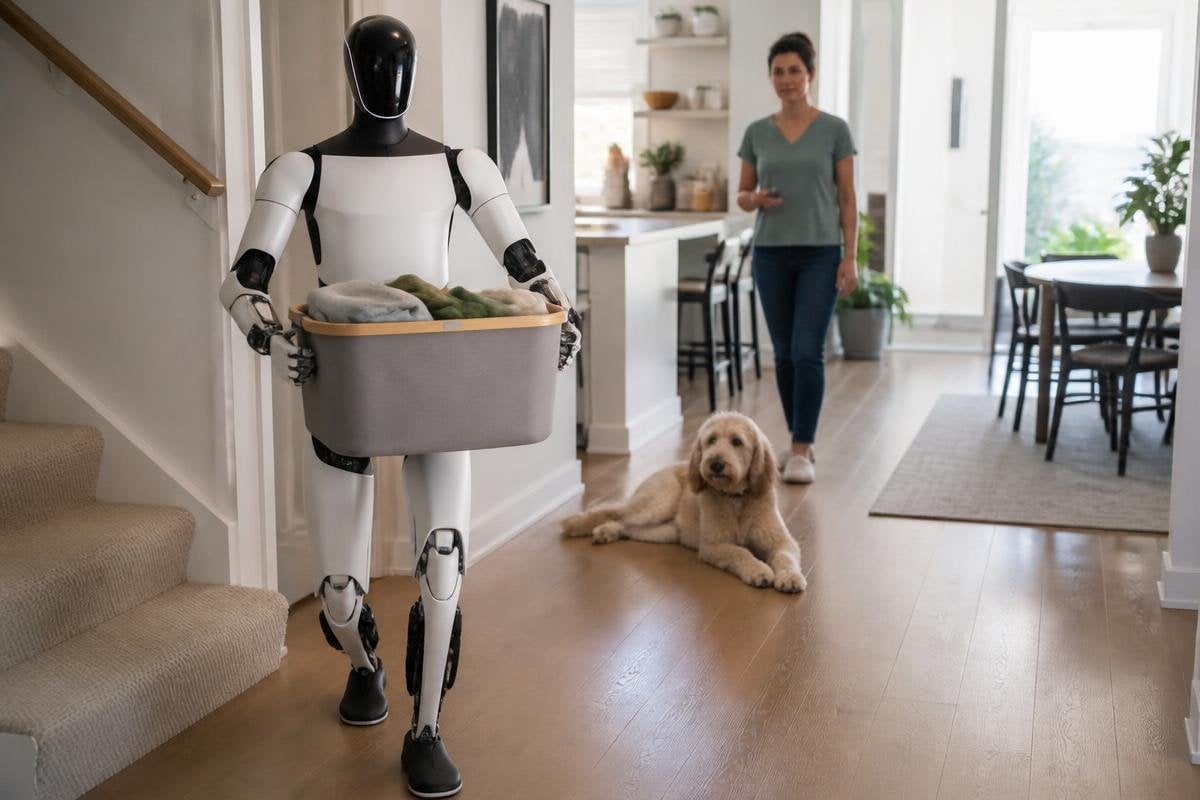
A humanoid robot could carry a basket, fetch an item, or move objects between rooms. The harder job is knowing what to do when a pet blocks the path, a cup breaks, or someone changes the request halfway through.
The question for a household buyer is practical: can one robot handle useful chores without constant help?
- Physical reach: Two arms and a human-sized body can work around furniture built for people.
- Home conditions: Lighting, clutter, stairs, pets, and loose objects make each task less predictable.
- Buying test: A useful assistant must finish chores safely, explain failures, and recover without a person taking over.
Where the shape helps
Humanoid robots use a body made for spaces built around people. Their hands can reach shelves, their legs can move through doorways, and their cameras can view objects from a standing height.
That shape matters when a home already has drawers, handles, steps, and work surfaces. You wouldn’t need to rebuild the kitchen for the robot. The trade is that walking and balancing add more parts that can fail than a wheeled base would need.
A personal assistant also needs more than motion. It must connect a spoken request to the right object, find that object, choose a safe grip, and place it where you asked. Each part can work on its own while the full task still fails.
The home is a hard test
Factories reduce surprises. Homes add them. A chair moves, a child leaves a toy on the floor, sunlight changes what a camera sees, and a wet dish behaves differently from a dry one.
The robot must build a working view of the room from sensors such as cameras, depth sensors, or LiDAR. It then needs to update that view as people and objects move. A wrong guess can send an arm toward the wrong cup or make the robot stop beside a doorway.
Safety raises the standard. A household machine works near people who may not know how its motors, joints, and grippers behave. It needs a clear stop control, limited force, and a safe response when it loses track of an object.
That last part gets less attention than a successful demo. A robot that asks for help after a failed lift may be more useful than one that completes a staged task but cannot explain a mistake.
What the assistant must do well
Useful home work has a clear start and finish. “Put the clothes in the basket” sounds easy, but the robot must find the clothes, tell them apart from the basket, avoid snagging fabric, and place each item without knocking something over.
The same pattern applies to food, cleaning, and deliveries inside the home. The robot needs enough grip control for fragile objects and enough force for heavier ones. It also needs software that can accept a correction without losing the task.
A home assistant must work around furniture, people, and objects with different weights, not only repeat one clean demo. Reporting from Robot 24 can show which home tasks have been tested, where a person had to step in, and what limits still affect daily use.
Cost will decide adoption. A household may accept a machine that handles one repeated chore, but a high price needs a clear reason to keep it running. That reason could be help with limited mobility, fewer trips across a large home, or work that a person cannot safely do.
What remains unproven
The open issue is reliability across ordinary days. A demo can show a robot completing a task once. A personal assistant must repeat that task after objects move, lighting changes, and instructions become less precise.
It also needs maintenance. Batteries need charging, joints need inspection, software needs updates, and a stuck robot needs a safe way to recover. If a person must reset it for every unusual event, the assistant becomes another system to supervise.
Privacy matters too. A robot that sees and hears inside the home collects information about rooms, routines, and people. Any buyer should ask where that data goes, how long it stays there, and which functions work without sending recordings away.
I’d wait before buying a humanoid for general household work unless the maker can show repeated tasks in ordinary homes, clear safety limits, repair support, and a price that matches the work it completes.
A buyer’s practical checklist
Use these checks before you treat a demo as a home product:
- Ask which chores the robot can finish without remote control.
- Check how it stops when a person enters its path.
- Find the listed battery run time and charging method.
- Test whether it can recover from a dropped or misplaced object.
- Read the data policy for cameras, microphones, and stored maps.
- Price repairs, software support, and replacement parts beside the purchase cost.
A humanoid robot can become a personal assistant when its body, software, safety controls, and support system work together through ordinary failures.
Until makers show that pattern outside prepared demonstrations, the practical market is likely to begin with narrow chores rather than one machine running the whole home.
